Restrictions for Rhode Island
Review Supervised Release restrictions in this federal district and the Sex Offender Registry requirements for the state of Rhode Island
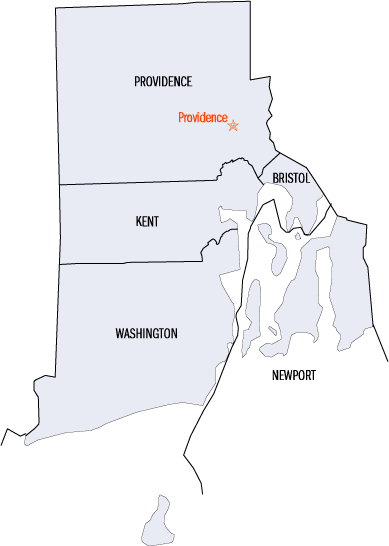

Below you will find information on standard conditions of supervision and travel restrictions, as well as sex offender registry requirements.
Always follow the conditions and restrictions given to you by your U.S. Probation Officer.
These are the standard conditions of supervision or probation the Court must impose. This does not include special conditions the court may impose.
Travel is a privilege not a right. No person is allowed to travel outside of their district during the first 60 days of supervision. This is to allow time for the proper referrals to be made and ensure compliance with the conditions of release. Travel permits must be submitted 10 days in advance to allow time to confirm the details and nature of the trip. It is regularly requested that offenders report to the office upon return to submit a urine specimen to ensure compliance with drug conditions while on travel. Generally offenders are not allowed to travel for pleasure if they are delinquent in their fees or if they have been considered non-compliant in the recent past. However, exceptions for travel restrictions are made in cases of verified emergencies.
A. Travel within the district: Travel within the district does not require a travel permit, however; if your stay will be overnight it is a good idea to let your officer know in case they are planning a home visit during your absence. This communication can build a rapport with your officer and further a positive relationship.
B. International Travel: Travel outside the United States requires the approval of the Court. This process can take up to a month to receive approval back from the court.
Every state and U.S. territory requires those convicted of sex offenses to be added to a registry to be monitored and tracked after their release back into the community. Information about the offender is collected and shared with local and federal authorities, as well as the general public. Requirements and restrictions are often placed on registered sex offenders. That registration process is unique in each state and U.S. territory.
The Sex Offender Registration and Notification Act (SORNA) was passed in 2006 as part of the Adam Walsh Child Protection and Safety Act to provide federal standards for jurisdictions to follow. SORNA calls for states and U.S. territories to meet minimum requirements for sex offender registration and notification.
While SORNA’s guidelines streamlined registration and notification requirements across the country, these requirements are far from uniform. Each jurisdiction determines the details of their own registration process. This leaves a patchwork of rules for sex offenders that vary widely depending on where a registrant lives or works.
Probation Information Network developed a list of questions regarding the sex offender registration requirements across the country. These are questions that might concern the public, victims and their advocates, or those who are facing registration or are currently registered and their loved ones. We then searched the statutes or code of each jurisdiction for the laws surrounding sex offender registration and notification. Where necessary, we consulted with the law enforcement agency in charge of the jurisdiction’s registry to provide clear and concise answers to the following questions:
How long must a sex offender remain on the registry? The length of time a sex offender must comply with registration requirements varies widely depending on the jurisdiction where the registrant lives, and the level of the offense committed. All but 2 jurisdictions offer a path for eventual removal from the registry for at least some of their registrants.
Every jurisdiction has passive community notification in the form of a public sex offender registry website. Concerned citizens are free to search the website and can sign up for email notifications if a sex offender moves into their neighborhood. Some jurisdictions go even further and require active notification, where either law enforcement or the offender themselves is required to directly notify the immediate community that a sex offender is in the area. This can take many forms, including electronic, mail, or in-person notification, publication in local newspapers, and community meetings.
Are there any restrictions on where a registered sex offender can live? Some jurisdictions restrict registrants from living within a measured distance of certain places. This restriction could be for all registrants, or only for higher-level offenders or those under supervision. Some jurisdictions do not have a state-wide restriction but do allow local jurisdictions to enact their own.
Registered sex offenders are usually restricted from certain types of employment, and from working at establishments that specifically cater to minors. Some jurisdictions go even further and restrict registrants from working within a measured distance of certain places.
Returning citizens of every type need to find employment upon reentry, and sex offenders are no exception. Some jurisdictions include registrants’ employment information on the public registry website. This could be the employer’s address or in some cases the name of the employer.
Some jurisdictions require registered sex offenders to report any identifiers they use online, such as email addresses and social media user names. In some jurisdictions that information is included on the public registry website, separate from the registrant’s profile, in a feature that allows the public to search by specific identifiers.
Some jurisdictions require a state-issued ID, such as a driver’s license, to be labeled to identify the holder as a registered sex offender. This label could be the words “Sex Offender” printed on the ID in a prominent place or a more subtle designation known to law enforcement.
Is there a fee to register as a sex offender? Some jurisdictions pass on some of their administrative costs to the registrants. This could be a one-time fee paid only upon initial registration, or an ongoing fee paid annually or quarterly. Some jurisdictions charge a fee every time a registrant updates their information.
Does a sex offender have to register if they work or go to school in a different state? It depends on the state, and how long the registrant will be there. Some jurisdictions require registrants to notify authorities immediately, while others allow limited stays without requiring registration. Registrants currently under supervision usually need permission from their Parole or Probation Officer before traveling and should always consult their supervising officer.
Can a registered sex offender go on vacation? Does a sex offender have to register if they visit a different state? It depends on the state, and how long the registrant will be there. Some jurisdictions require registrants to notify authorities immediately, while others allow limited stays without requiring registration. Registrants currently under supervision usually need permission from their Parole or Probation Officer before traveling and should always consult their supervising officer.
The answers provided are taken directly from the laws found on the state or territory’s legislative website or, where necessary, from the website of the law enforcement agency in charge of the jurisdiction’s registry. In some cases, we contacted state or territory officials for clarification and have directly quoted those conversations.
While we stand by our research, it is for informational purposes only. It should not be considered legal advice and, while we strive to provide accurate and up to date information, it is not guaranteed to be complete or correct. We provide links to each jurisdiction’s legislative and law enforcement websites and maintain a directory of lawyers who specialize in sex offender registration laws. For those currently under supervision, consult with your Parole or Probation Officer for guidance.
RI Gen L § 11-37.1-4
(a) Annual registration. Any person required to register under § 11-37.1-3(a)(1) or (2) shall annually register with the local law enforcement agency having jurisdiction over the city or town in which the person having the duty to register resides for a period of ten (10) years from the expiration of sentence for the offense and shall verify his or her address with the agency on a quarterly basis for the first two (2) years of the period unless the person has been determined to be a sexually violent predator in accordance with § 11-37.1-6 or unless the person is required to register for the life of that person in accordance with the provisions of subsection (c) of this section.
(b) Sexually violent predators. Any person who has been determined to be a sexually violent predator in accordance with the provisions of § 11-37.1-6 shall be required to annually register in person with the local law enforcement agency having jurisdiction over the city or town in which the person having the duty to register resides for the life of that person and to verify his or her address on a quarterly basis for the life of that person.
(c) Recidivists and aggravated crime offenders. Any person required to register under § 11-37.1-3 and who has one or more prior convictions for any offense described in § 11-37.1-2 or has been convicted of an aggravated offense as defined in § 11-37.1-2 shall annually register in person with the local law enforcement agency having jurisdiction over the city or town in which the person having the duty to register resides for the life of that person and to verify his or her address on a quarterly basis for the life of that person.
RI Gen L § 11-37.1-11
(5) Information shall be disclosed by the local police department to the general public in a city or town for those registered offenders determined to be either a level 2 or level 3 offender as determined consistent with parole board guidelines; and
(6) Information shall be disclosed by the local police department to the local school department for those registered offenders determined to be level 3 offenders by the parole board for the purposes of notifying parents of students whose school bus stop is within one thousand feet (1,000′) of a level 3 sex offender’s residence, which distance shall be measured from the nearest boundary line of the real property supporting the residence of the level 3 sex offender to the school bus stop.
RI Gen L § 11-37.1-12
(b)(1) If risk of re-offense is low, law enforcement agencies and any individuals identified in accordance with the parole board guidelines shall be notified;
(2) If risk of re-offense is moderate, organizations in the community likely to encounter the person registered shall be notified in accordance with the parole board’s guidelines, in addition to the notice required by subsection (b)(1);
(3) If risk of re-offense is high, the members of the public likely to encounter the person registered shall be notified through means in accordance with the parole board’s guidelines designed to reach members of the public likely to encounter the person registered, in addition to the notice required by subsections (b)(1) and (b)(2).
(4) The designated state law enforcement agency is authorized and directed to utilize the Rhode Island state police website and the Rhode Island unified court system website for the public release of identifying information of level two and level three sex offenders who have been convicted, provided that no identifying information of a juvenile shall be listed on the website.
There is a process outlined in RI Gen L § 11-37.1-13 through 16 by which a tier 2 or 3 registrant may object to community notification.
RI Gen L § 11-37.1-10
(c) Except in the case of a level-three (3) sex offender, any person who is required to register or verify his or her address, who knowingly resides within three hundred feet (300′) of any school as defined in § 11-37.1-2, which distance shall be measured from the nearest boundary line of the real property supporting the residence of the person to the nearest boundary line of the real property that supports or upon which there exists a school shall be guilty of a felony and, upon conviction, may be imprisoned not more than five (5) years, or fined not more than five thousand dollars ($5,000), or both.
(d) Any level-three (3) sex offender who knowingly resides within one thousand feet (1,000′) of any school as defined in § 11-37.1-2, which distance shall be measured from the nearest boundary line of the real property supporting the residence of the person to the nearest boundary line of the real property that supports or upon which there exists a school shall be guilty of a felony and, upon conviction, may be imprisoned for not more than five (5) years, or fined not more than five thousand dollars ($5,000), or both.
None.
No.
No.
RI Gen L § 11-37.1-12
(b) (4) (iii) (H) The following information shall not be available to the public on the sex offender registry website:
(V) Internet identifiers (as defined in 42 U.S.C. § 16911);
No.
There is no state-mandated fee, though fees may be assessed by local law enforcement.
RI Gen L § 11-37.1-4
(h) All nonresident workers or students who are required to register under this chapter shall perform their initial registration by appearing in person at the local law enforcement agency in the city or town in which the person is employed or is attending a public or private educational institution within twenty-four (24) hours of their first day of their personal attendance at their place of employment or a public or private educational institution.
RI Gen L § 11-37.1-4
(g) All persons required to register under this chapter who are moving their residence to Rhode Island from another jurisdiction shall perform their initial registration by appearing in person at the local law enforcement agency in the city or town in which the person intends to reside within twenty-four (24) hours of their arrival in Rhode Island.