Restrictions for Georgia
Review Supervised Release restrictions in each of the federal districts and the Sex Offender Registry requirements for the state of Georgia
Below you will find information on standard conditions of supervision and travel restrictions, as well as sex offender registry requirements.
Always follow the conditions and restrictions given to you by your U.S. Probation Officer.
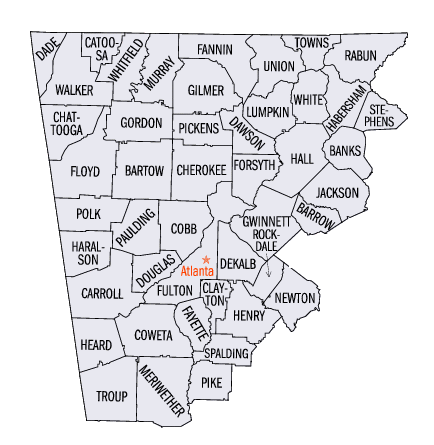
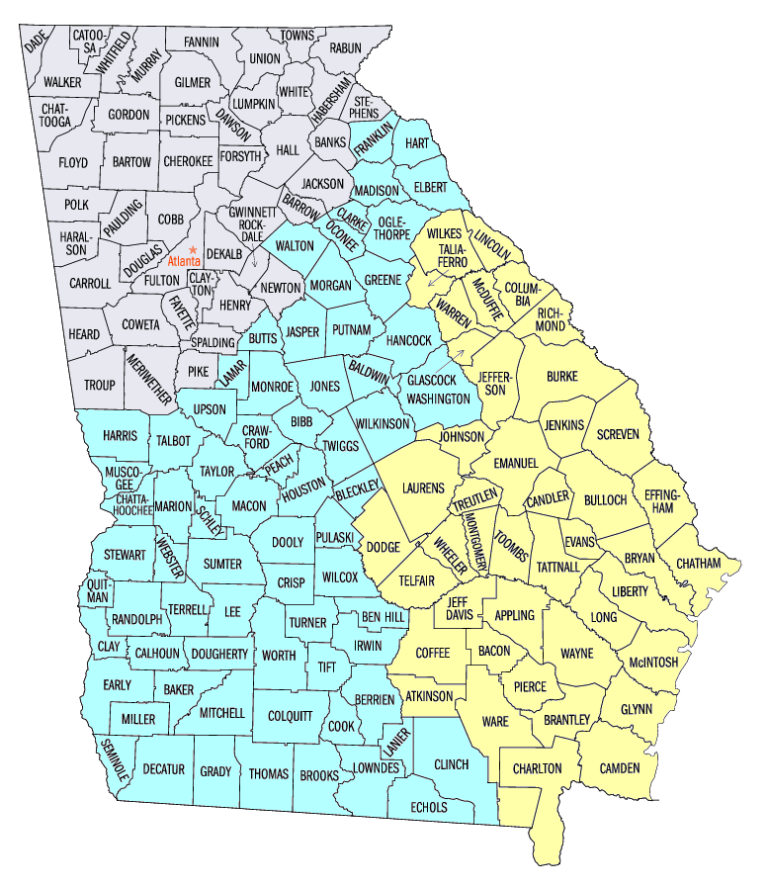
While under supervised release, probation, or parole supervision in the Northern District of Georgia, the following travel restrictions and procedures are applicable. You are free to travel within the Northern District of Georgia (map available in this section); however, travel outside the Northern District of Georgia is governed by the following:
1. Travel outside the district is a privilege and is not automatically granted. All travel outside the district shall be verified and approved by the Probation Officer. Therefore, request for travel must be submitted on a travel request form at least ___ 1days in advance of anticipated travel in order that such verification and approval may be accomplished prior to the departure date.
2. Non-essential travel outside the district will be prohibited during the first 60 days of supervision. The Probation Officer will determine if travel requests during this time are necessary. If travel is granted, it must be verified.
3. Non-essential travel outside the district will be prohibited for anyone who is delinquent on payment of his/her court-ordered financial obligations (special assessment, fine, or restitution). The Probation Officer will determine if the requested travel is essential and, if so, verification will be necessary.
4. If convicted of a drug offense or if you have a documented history of drug trafficking or distribution, your travel outside the district will be restricted unless the Probation Officer is thoroughly satisfied that your travel is legitimate.
5. All essential travel outside the United States must be approved by the sentencing judge or the U.S. Parole Commission. This process may require at least 30 days so requests for such travel must be submitted at least ___ 2days in advance of anticipated travel.
Having been instructed by the Court/Parole Commission to participate in drug and/or alcohol aftercare, I agree to assist the Probation Office in monitoring my drug and/or alcohol free status by abiding by the following:
Having been instructed by the Court/Parole Commission to participate in mental health aftercare, I agree to assist the Probation Office in monitoring my mental health status by abiding by the following:
Having been instructed by the Court to participate in sex offender evaluation/counseling, I agree to assist the Probation Office in monitoring my compliance by abiding by the following:
1. I understand that my employment and residence must be approved by my U.S. Probation Officer. I will obtain permission prior to changing my employment or residence.
2. I will not date or marry anyone who has children under the age of eighteen (18) unless I have obtained approval from my U.S. Probation Officer and treatment provider. I also understand that I am to notify such person of my criminal history.
3. I understand that I am not to possess, purchase, or subscribe to any sexually oriented material or pornography to include mail, computer, telephone (900 telephone numbers), video, or television, nor patronize any place where such material or entertainment is available.
4. I will not frequent places or loiter near schools, playgrounds, parks, swimming pools, arcades, or other places primarily used by children under the age of eighteen (18) without the approval of my U.S. Probation Officer and treatment provider.
5. I will attend and actively participate in sex offender evaluation and treatment at a program approved by my U.S. Probation Officer. I will abide by the rules of the treatment program and successfully complete the program to the satisfaction of the U.S. Probation Officer and the treatment provider. I will be financially responsible for all evaluations and treatment unless other arrangements have been made by my U.S. Probation Officer or treatment provider.
6. I will submit to any program of psychological or physiological assessment at the direction of the U.S. Probation Officer or treatment provider. This includes the polygraph and/or plethysmograph to assist in treatment, treatment planning, and case monitoring.
7. If directed, I will maintain a driving log (mileage, time of departure, arrival, and return, destination, routes traveled, with whom, etc.) and make it available at the request of my U.S. Probation Officer. I will not “cruise” around with no destination. All out of district travel must be approved by my USPO no less than 30 days in advance.
8. I will not utilize a Post Office Box without the approval of my U.S. Probation Officer.
9. I will not associate or correspond with any known sex offender except in an approved treatment program setting, without the permission of my U.S. Probation Officer.
10. I will not possess children’s clothing, toys, games, etc. without the approval of my U.S. Probation Officer.
11. I will not have any contact with the victim(s) in my case, including correspondence, telephone contact, any form of electronic communication, or communication through a third party unless approved by my U.S. Probation Officer and treatment provider.
12. I understand that I must disclose my offense to my spouse or significant other if third party risk is assessed by my U.S. Probation Officer.
13. I will provide all personal/business phone records to the U.S. Probation Officer upon request. I will provide written authorization to request a record of all outgoing or incoming phone calls from any phone service provider. Further, I will obtain written approval from my U.S. Probation Officer to use an electronic bulletin board system, services that provide access to the internet, or any public or private computer network. I will obtain written approval from my U.S. Probation Officer to possess or use any computer at any location including employment. I will permit routine inspection of any computer systems, hard drives, and other media storage materials to confirm compliance with this condition. This inspection shall be no more intrusive than is necessary to ensure compliance with this condition. Any computer system which is accessible to me is subject to inspection. I will permit confiscation and/or disposal of any material considered contraband.
14. I will have no contact, whether directly in person or indirectly through any means of communication, with any child under the age of eighteen (18), including my own children, nor with any person unable to give consent due to mental or emotional limitations without the approval of my U.S. Probation Officer and treatment provider. If I have incidental contact with children, I will be civil and courteous to the child and immediately remove myself from the situation. I will also notify my U.S. Probation Officer of such contact within 72 hours and include a written description of the incident and submit with my monthly report.
15. If applicable, I must register as a sex offender with the local sheriff within 72 hours of being released or placed on supervised release. I understand that I must register within 72 hours if I change any of the required registration information, other than residence address. If there is a change in residence address, I must register this information within 72 hours prior to moving. Registration is required annually for life. (Mandated by the O.C.G.A. 42-01-12, Sex Offender Registration and/or Federal Public Law No. 105-119, Title I, section 115, 111 Stat. 2240, 18 USC 3563(a) and 3583 (d).
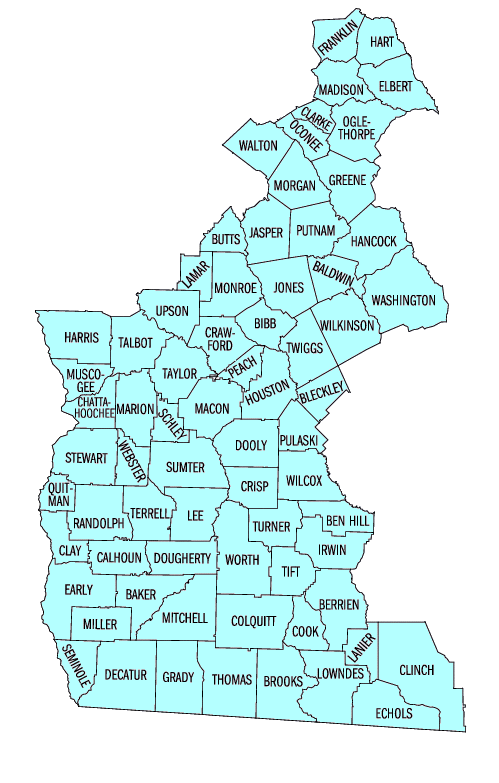
Probation Officers approve or deny travel requests based on the duties assigned to this agency by Statute, Monograph, or the Court. In the Middle District of Georgia, recurring travel should be limited, as supervision of an offender is inhibited otherwise.
For each request, completed travel permits will be issued and copied to the district of travel. Non-emergency requests should be made at least 10 days in advance.
Post-Conviction Supervision
Requests for travel outside of the United States must be approved by the Court or the Parole Commission. Vacation travel exceeding 30 days must be approved by the Court. Otherwise, the Probation Officer has the authority to approve all other requests for travel outside of the district.
Pretrial Supervision
The Court must approve international travel.
For travel requiring Court or Parole Commission approval, it is suggested 30 days advance notice be given.
Having been instructed by the Court/Parole Commission to participate in drug and/or alcohol aftercare, I agree to assist the Probation Office in monitoring my drug and/or alcohol free status by abiding by the following:
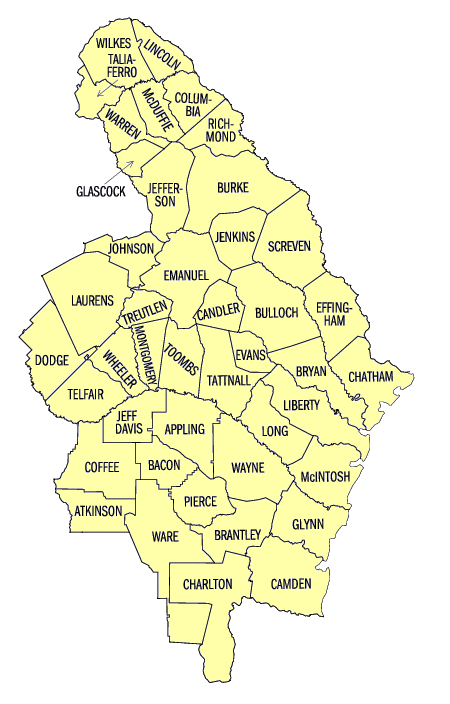
The Southern District of Georgia is comprised of 43 counties. You are allowed to travel freely within these 43 counties. Unless you are given permission in advance by the judge in your case, any requests to travel outside of these 43 counties must be approved in advance by your U.S. Probation Officer.
Failure to do so may result in a violation of your supervision.
Every state and U.S. territory requires those convicted of sex offenses to be added to a registry to be monitored and tracked after their release back into the community. Information about the offender is collected and shared with local and federal authorities, as well as the general public. Requirements and restrictions are often placed on registered sex offenders. That registration process is unique in each state and U.S. territory.
The Sex Offender Registration and Notification Act (SORNA) was passed in 2006 as part of the Adam Walsh Child Protection and Safety Act to provide federal standards for jurisdictions to follow. SORNA calls for states and U.S. territories to meet minimum requirements for sex offender registration and notification.
While SORNA’s guidelines streamlined registration and notification requirements across the country, these requirements are far from uniform. Each jurisdiction determines the details of their own registration process. This leaves a patchwork of rules for sex offenders that vary widely depending on where a registrant lives or works.
Probation Information Network developed a list of questions regarding the sex offender registration requirements across the country. These are questions that might concern the public, victims and their advocates, or those who are facing registration or are currently registered and their loved ones. We then searched the statutes or code of each jurisdiction for the laws surrounding sex offender registration and notification. Where necessary, we consulted with the law enforcement agency in charge of the jurisdiction’s registry to provide clear and concise answers to the following questions:
How long must a sex offender remain on the registry? The length of time a sex offender must comply with registration requirements varies widely depending on the jurisdiction where the registrant lives, and the level of the offense committed. All but 2 jurisdictions offer a path for eventual removal from the registry for at least some of their registrants.
Every jurisdiction has passive community notification in the form of a public sex offender registry website. Concerned citizens are free to search the website and can sign up for email notifications if a sex offender moves into their neighborhood. Some jurisdictions go even further and require active notification, where either law enforcement or the offender themselves is required to directly notify the immediate community that a sex offender is in the area. This can take many forms, including electronic, mail, or in-person notification, publication in local newspapers, and community meetings.
Are there any restrictions on where a registered sex offender can live? Some jurisdictions restrict registrants from living within a measured distance of certain places. This restriction could be for all registrants, or only for higher-level offenders or those under supervision. Some jurisdictions do not have a state-wide restriction but do allow local jurisdictions to enact their own.
Registered sex offenders are usually restricted from certain types of employment, and from working at establishments that specifically cater to minors. Some jurisdictions go even further and restrict registrants from working within a measured distance of certain places.
Returning citizens of every type need to find employment upon reentry, and sex offenders are no exception. Some jurisdictions include registrants’ employment information on the public registry website. This could be the employer’s address or in some cases the name of the employer.
Some jurisdictions require registered sex offenders to report any identifiers they use online, such as email addresses and social media user names. In some jurisdictions that information is included on the public registry website, separate from the registrant’s profile, in a feature that allows the public to search by specific identifiers.
Some jurisdictions require a state-issued ID, such as a driver’s license, to be labeled to identify the holder as a registered sex offender. This label could be the words “Sex Offender” printed on the ID in a prominent place or a more subtle designation known to law enforcement.
Is there a fee to register as a sex offender? Some jurisdictions pass on some of their administrative costs to the registrants. This could be a one-time fee paid only upon initial registration, or an ongoing fee paid annually or quarterly. Some jurisdictions charge a fee every time a registrant updates their information.
Does a sex offender have to register if they work or go to school in a different state? It depends on the state, and how long the registrant will be there. Some jurisdictions require registrants to notify authorities immediately, while others allow limited stays without requiring registration. Registrants currently under supervision usually need permission from their Parole or Probation Officer before traveling and should always consult their supervising officer.
Can a registered sex offender go on vacation? Does a sex offender have to register if they visit a different state? It depends on the state, and how long the registrant will be there. Some jurisdictions require registrants to notify authorities immediately, while others allow limited stays without requiring registration. Registrants currently under supervision usually need permission from their Parole or Probation Officer before traveling and should always consult their supervising officer.
The answers provided are taken directly from the laws found on the state or territory’s legislative website or, where necessary, from the website of the law enforcement agency in charge of the jurisdiction’s registry. In some cases, we contacted state or territory officials for clarification and have directly quoted those conversations.
While we stand by our research, it is for informational purposes only. It should not be considered legal advice and, while we strive to provide accurate and up to date information, it is not guaranteed to be complete or correct. We provide links to each jurisdiction’s legislative and law enforcement websites and maintain a directory of lawyers who specialize in sex offender registration laws. For those currently under supervision, consult with your Parole or Probation Officer for guidance.
GA Code § 42-1-19
Petition for release from registration requirements.
(a) An individual required to register pursuant to Code Section 42-1-12 may petition a superior court for release from registration requirements and from any residency or employment restrictions of this article if the individual:
(1) Has completed all prison, parole, supervised release, and probation for the offense which required registration pursuant to Code Section 42-1-12 and:
(A) Is confined to a hospice facility, skilled nursing home, residential care facility for the elderly, or nursing home;
(B) Is totally and permanently disabled as such term is defined in Code Section 49-4-80;
(C) Is otherwise seriously physically incapacitated due to illness or injury; or
(D) Has reached the age of 80 years;
(2) Was sentenced for a crime that became punishable as a misdemeanor on or after July 1, 2006, and meets the criteria set forth in subparagraphs (c)(1)(A) through (c)(1)(F) of Code Section 17-10-6.2;
(3) Is required to register solely because he or she was convicted of kidnapping or false imprisonment involving a minor and such offense did not involve a sexual offense against such minor or an attempt to commit a sexual offense against such minor. For purposes of this paragraph, the term “sexual offense” means any offense listed in division (a)(10)(B)(i) or (a)(10)(B)(iv) through (a)(10)(B)(xix) of Code Section 42-1-12;
(4) Has completed all prison, parole, supervised release, and probation for the offense which required registration pursuant to Code Section 42-1-12 and meets the criteria set forth in subparagraphs (c)(1)(A) through (c)(1)(F) of Code Section 17-10-6.2; or
(5) Was convicted of a sexual offense and required to register under the laws of another state or territory, under the laws of the United States, under the Uniform Code of Military Justice, or in a tribal court and:
(A) Has completed all prison, parole, supervised release, and probation for the offense which required registration pursuant to Code Section 42-1-12 and meets the criteria set forth in subparagraphs (c)(1)(A) through (c)(1)(F) of Code Section 17-10-6.2; and
(B) Has been removed from the registry in the other state or territory and can provide the court with documentation supporting the same.
(b)
(1) A petition for release pursuant to this Code section shall be filed in the superior court of the jurisdiction in which the individual was convicted; provided, however, that, if the individual was not convicted in this state, such petition shall be filed in the superior court of the county where the individual resides.
(2) Such petition shall be served on the district attorney of the jurisdiction where the petition is filed, the sheriff of the county where the petition is filed, and the sheriff of the county where the individual resides. Service on the district attorney and sheriff may be had by mailing a copy of the petition with a proper certificate of service.
(3) If a petition for release is denied, another petition for release shall not be filed within a period of two years from the date of the final order on a previous petition.
(c)
(1) An individual who meets the requirements of paragraph (1), (2), or (3) of subsection (a) of this Code section shall be considered for release from registration requirements and from residency or employment restrictions.
(2) An individual who meets the requirements of paragraph (4) of subsection (a) of this Code section may be considered for release from registration requirements and from residency or employment restrictions only if:
(A) Five years have elapsed since the individual completed all prison, parole, supervised release, and probation for the offense which required registration pursuant to Code Section 42-1-12; and
(B) The individual has been classified by the board as a Level I risk assessment classification, provided that, if the board has not done a risk assessment classification for such individual within the last five years, the court shall order such classification to be completed prior to considering the petition for release.
(3) An individual who meets the requirements of paragraph (5) of subsection (a) of this Code section may be considered for release from registration requirements and from residency or employment restrictions only if:
(A) Ten years have elapsed since the individual completed all prison, parole, supervised release, and probation for the offense which required registration pursuant to Code Section 42-1-12; and
(B) The individual has been classified by the board as a Level I risk assessment classification, provided that, if the board has not done a risk assessment classification for such individual within the last five years, the court shall order such classification to be completed prior to considering the petition for release.
No.
GA Code § 42-1-12
(a) As used in this article, the term:
(3) “Area where minors congregate” shall include all public and private parks and recreation facilities, playgrounds, skating rinks, neighborhood centers, gymnasiums, school bus stops, public libraries, and public and community swimming pools.
GA Code § 42-1-15
(b) On and after July 1, 2008, no individual shall reside within 1,000 feet of any child care facility, church, school, or area where minors congregate if the commission of the act for which such individual is required to register occurred on or after July 1, 2008. Such distance shall be determined by measuring from the outer boundary of the property on which the individual resides to the outer boundary of the property of the child care facility, church, school, or area where minors congregate at their closest points.
-Or-
GA Code § 42-1-16
(a) As used in this Code section, the term:
(1) “Area where minors congregate” shall include all public and private parks and recreation facilities, playgrounds, skating rinks, neighborhood centers, gymnasiums, school bus stops, and public and community swimming pools.
(b) Any individual who committed an act between July 1, 2006, and June 30, 2008, for which such individual is required to register shall not reside within 1,000 feet of any child care facility, church, school, or area where minors congregate. Such distance shall be determined by measuring from the outer boundary of the property on which the individual resides to the outer boundary of the property of the child care facility, church, school, or area where minors congregate at their closest points.
-Or-
GA Code § 42-1-17
(a) As used in this Code section, the term:
(1) “Area where minors congregate” shall include all public and private parks and recreation facilities, playgrounds, skating rinks, neighborhood centers, gymnasiums, and similar facilities providing programs or services directed towards persons under 18 years of age.
(b) Any individual who committed an act between June 4, 2003, and June 30, 2006, for which such individual is required to register shall not reside within 1,000 feet of any child care facility, school, or area where minors congregate. Such distance shall be determined by measuring from the outer boundary of the property on which the individual resides to the outer boundary of the property of the child care facility, school, or area where minors congregate at their closest points.
GA Code § 42-1-12
(a) As used in this article, the term:
(3) “Area where minors congregate” shall include all public and private parks and recreation facilities, playgrounds, skating rinks, neighborhood centers, gymnasiums, school bus stops, public libraries, and public and community swimming pools.
GA Code § 42-1-15
(c)
(1) On and after July 1, 2008, no individual shall be employed by or volunteer at any child care facility, school, or church or by or at any business or entity that is located within 1,000 feet of a child care facility, a school, or a church if the commission of the act for which such individual is required to register occurred on or after July 1, 2008. Such distance shall be determined by measuring from the outer boundary of the property of the location at which such individual is employed or volunteers to the outer boundary of the child care facility, school, or church at their closest points.
(2) On or after July 1, 2008, no individual who is a sexually dangerous predator shall be employed by or volunteer at any business or entity that is located within 1,000 feet of an area where minors congregate if the commission of the act for which such individual is required to register occurred on or after July 1, 2008. Such distance shall be determined by measuring from the outer boundary of the property of the location at which the sexually dangerous predator is employed or volunteers to the outer boundary of the area where minors congregate at their closest points.
-Or-
GA Code § 42-1-16
(a) As used in this Code section, the term:
(1) “Area where minors congregate” shall include all public and private parks and recreation facilities, playgrounds, skating rinks, neighborhood centers, gymnasiums, school bus stops, and public and community swimming pools.
(c)
(1) Any individual who committed an act between July 1, 2006, and June 30, 2008, for which such individual is required to register shall not be employed by any child care facility, school, or church or by or at any business or entity that is located within 1,000 feet of a child care facility, a school, or a church. Such distance shall be determined by measuring from the outer boundary of the property of the location at which such individual is employed to the outer boundary of the child care facility, school, or church at their closest points.
(2) Any individual who committed an act between July 1, 2006, and June 30, 2008, for which such individual is required to register who is a sexually dangerous predator shall not be employed by any business or entity that is located within 1,000 feet of an area where minors congregate. Such distance shall be determined by measuring from the outer boundary of the property of the location at which the sexually dangerous predator is employed to the outer boundary of the area where minors congregate at their closest points.
No.
No.
No.
There is no state-mandated fee, though fees may be assessed by local law enforcement.
GA Code § 42-1-12
(e) Registration pursuant to this Code section shall be required by any individual who:
(7) Is a nonresident sexual offender who enters this state for the purpose of employment or any other reason for a period exceeding 14 consecutive days or for an aggregate period of time exceeding 30 days during any calendar year regardless of whether such sexual offender is required to register under federal law, military law, tribal law, or the laws of another state or territory; or
(8) Is a nonresident sexual offender who enters this state for the purpose of attending school as a full-time or part-time student regardless of whether such sexual offender is required to register under federal law, military law, tribal law, or the laws of another state or territory.
GA Code § 42-1-12
(e) Registration pursuant to this Code section shall be required by any individual who:
(7) Is a nonresident sexual offender who enters this state for the purpose of employment or any other reason for a period exceeding 14 consecutive days or for an aggregate period of time exceeding 30 days during any calendar year regardless of whether such sexual offender is required to register under federal law, military law, tribal law, or the laws of another state or territory;