Restrictions for Florida
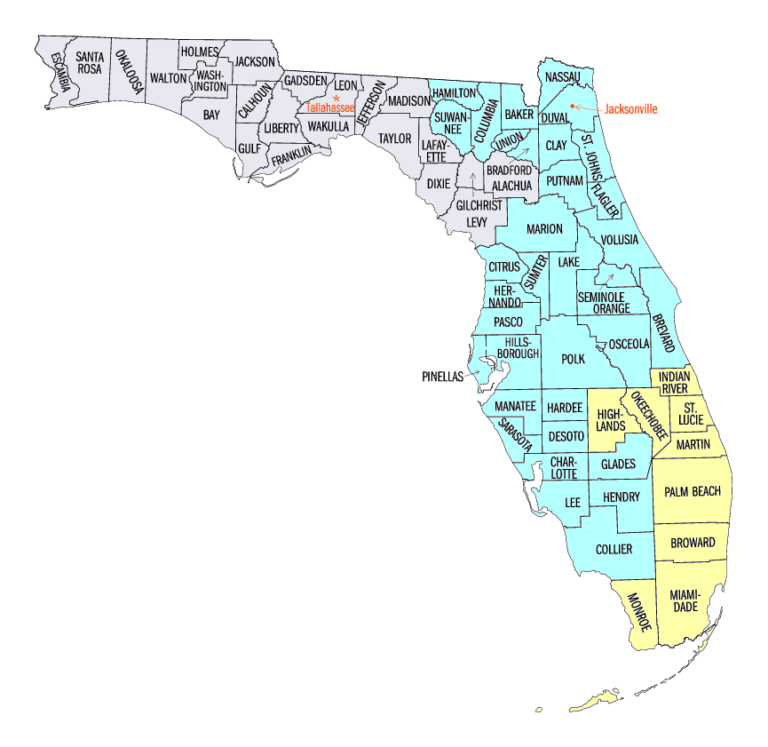
Review Supervised Release restrictions in each of the federal districts and the Sex Offender Registry requirements for the state of Florida

FL Stat § 943.0435
(11) Except as provided in s. 943.04354, a sexual offender shall maintain registration with the department for the duration of his or her life unless the sexual offender has received a full pardon or has had a conviction set aside in a postconviction proceeding for any offense that meets the criteria for classifying the person as a sexual offender for purposes of registration. However, a sexual offender shall be considered for removal of the requirement to register as a sexual offender only if the person:
(a)1. Has been lawfully released from confinement, supervision, or sanction, whichever is later, for at least 25 years and has not been arrested for any felony or misdemeanor offense since release, provided that the sexual offender’s requirement to register was not based upon an adult conviction:
a. For a violation of s. 787.01 or s. 787.02;
b. For a violation of s. 794.011, excluding s. 794.011(10);
c. For a violation of s. 800.04(4)(a)2. where the court finds the offense involved a victim under 12 years of age or sexual activity by the use of force or coercion;
d. For a violation of s. 800.04(5)(b);
e. For a violation of s. 800.04(5)(c)2. where the court finds the offense involved the use of force or coercion and unclothed genitals or genital area;
f. For a violation of s. 825.1025(2)(a);
g. For any attempt or conspiracy to commit any such offense;
h. For a violation of similar law of another jurisdiction; or
i. For a violation of a similar offense committed in this state which has been redesignated from a former statute number to one of those listed in this subparagraph.
FL Stat § 775.21
(7) (a) Law enforcement agencies must inform members of the community and the public of a sexual predator’s presence. Upon notification of the presence of a sexual predator, the sheriff of the county or the chief of police of the municipality where the sexual predator establishes or maintains a permanent or temporary residence shall notify members of the community and the public of the presence of the sexual predator in a manner deemed appropriate by the sheriff or the chief of police. Within 48 hours after receiving notification of the presence of a sexual predator, the sheriff of the county or the chief of police of the municipality where the sexual predator temporarily or permanently resides shall notify each licensed child care facility, elementary school, middle school, and high school within a 1-mile radius of the temporary or permanent residence of the sexual predator of the presence of the sexual predator. Information provided to members of the community and the public regarding a sexual predator must include:
This paragraph does not authorize the release of the name of any victim of the sexual predator.
FL Stat § 775.215
(2)(a) A person who has been convicted of a violation of s. 794.011, s. 800.04, s. 827.071, s. 847.0135(5), or s. 847.0145, regardless of whether adjudication has been withheld, in which the victim of the offense was less than 16 years of age, may not reside within 1,000 feet of any school, child care facility, park, or playground. However, a person does not violate this subsection and may not be forced to relocate if he or she is living in a residence that meets the requirements of this subsection and a school, child care facility, park, or playground is subsequently established within 1,000 feet of his or her residence.
(c) This subsection applies to any person convicted of a violation of s. 794.011, s. 800.04, s. 827.071, s. 847.0135(5), or s. 847.0145 for offenses that occur on or after October 1, 2004, excluding persons who have been removed from the requirement to register as a sexual offender or sexual predator pursuant to s. 943.04354.
(3)(a) A person who has been convicted of an offense in another jurisdiction that is similar to a violation of s. 794.011, s. 800.04, s. 827.071, s. 847.0135(5), or s. 847.0145, regardless of whether adjudication has been withheld, in which the victim of the offense was less than 16 years of age, may not reside within 1,000 feet of any school, child care facility, park, or playground. However, a person does not violate this subsection and may not be forced to relocate if he or she is living in a residence that meets the requirements of this subsection and a school, child care facility, park, or playground is subsequently established within 1,000 feet of his or her residence.
(c) This subsection applies to any person convicted of an offense in another jurisdiction that is similar to a violation of s. 794.011, s. 800.04, s. 827.071, s. 847.0135(5), or s. 847.0145 if such offense occurred on or after May 26, 2010, excluding persons who have been removed from the requirement to register as a sexual offender or sexual predator pursuant to s. 943.04354.
FL Stat § 775.21
(10)(b) A sexual predator who has been convicted of or found to have committed, or has pled nolo contendere or guilty to, regardless of adjudication, any violation, or attempted violation, of s. 787.01, s. 787.02, or s. 787.025(2)(c), where the victim is a minor; s. 794.011, excluding s. 794.011(10); s. 794.05; former s. 796.03; former s. 796.035; s. 800.04; s. 827.071; s. 847.0133; s. 847.0135(5); s. 847.0145; or s. 985.701(1); or a violation of a similar law of another jurisdiction when the victim of the offense was a minor, and who works, whether for compensation or as a volunteer, at any business, school, child care facility, park, playground, or other place where children regularly congregate, commits a felony of the third degree, punishable as provided in s. 775.082, s. 775.083, or s. 775.084.
No.
Offenders must register email addresses and internet identifiers. While this information is not included on an offender’s registry profile, there is a separate search feature that allows the public to search by specific email addresses or internet identifiers.
FL Stat § 943.0435
(4)(e)1. A sexual offender shall register all electronic mail addresses and Internet identifiers, and each Internet identifier’s corresponding website homepage or application software name, with the department through the department’s online system or in person at the sheriff’s office within 48 hours after using such electronic mail addresses or Internet identifiers. If the sexual offender is in the custody or control, or under the supervision, of the Department of Corrections, he or she must report all electronic mail addresses and Internet identifiers, and each Internet identifier’s corresponding website homepage or application software name, to the Department of Corrections before using such electronic mail addresses or Internet identifiers. If the sexual offender is in the custody or control, or under the supervision, of the Department of Juvenile Justice, he or she must report all electronic mail addresses and Internet identifiers, and each Internet identifier’s corresponding website homepage or application software name, to the Department of Juvenile Justice before using such electronic mail addresses or Internet identifiers.
Yes.
FL Stat § 322.141
(3) All licenses for the operation of motor vehicles or identification cards originally issued or reissued by the department to persons who are designated as sexual predators under s. 775.21 or subject to registration as sexual offenders under s. 943.0435 or s. 944.607, or who have a similar designation or are subject to a similar registration under the laws of another jurisdiction, shall have on the front of the license or identification card the following:
(a) For a person designated as a sexual predator under s. 775.21 or who has a similar designation under the laws of another jurisdiction, the marking “SEXUAL PREDATOR.”
(b) For a person subject to registration as a sexual offender under s. 943.0435 or s. 944.607, or subject to a similar registration under the laws of another jurisdiction, the marking “943.0435, F.S.”
There is no state-mandated fee, though fees may be assessed by local law enforcement.
FL Stat § 775.21
(2)(k) “Permanent residence” means a place where the person abides, lodges, or resides for 3 or more consecutive days. For the purpose of calculating a permanent residence under this paragraph, the first day that a person abides, lodges, or resides at a place is excluded and each subsequent day is counted. A day includes any part of a calendar day.
(n) “Temporary residence” means a place where the person abides, lodges, or resides, including, but not limited to, vacation, business, or personal travel destinations in or out of this state, for a period of 3 or more days in the aggregate during any calendar year and which is not the person’s permanent address or, for a person whose permanent residence is not in this state, a place where the person is employed, practices a vocation, or is enrolled as a student for any period of time in this state. For the purpose of calculating a temporary residence under this paragraph, the first day that a person abides, lodges, or resides at a place is excluded and each subsequent day is counted. A day includes any part of a calendar day.
FL Stat § 775.21
(2)(n) “Temporary residence” means a place where the person abides, lodges, or resides, including, but not limited to, vacation, business, or personal travel destinations in or out of this state, for a period of 3 or more days in the aggregate during any calendar year and which is not the person’s permanent address or, for a person whose permanent residence is not in this state, a place where the person is employed, practices a vocation, or is enrolled as a student for any period of time in this state. For the purpose of calculating a temporary residence under this paragraph, the first day that a person abides, lodges, or resides at a place is excluded and each subsequent day is counted. A day includes any part of a calendar day.