Restrictions for Arkansas
Review Supervised Release restrictions in each of the federal districts and the Sex Offender Registry requirements for the state of Arkansas
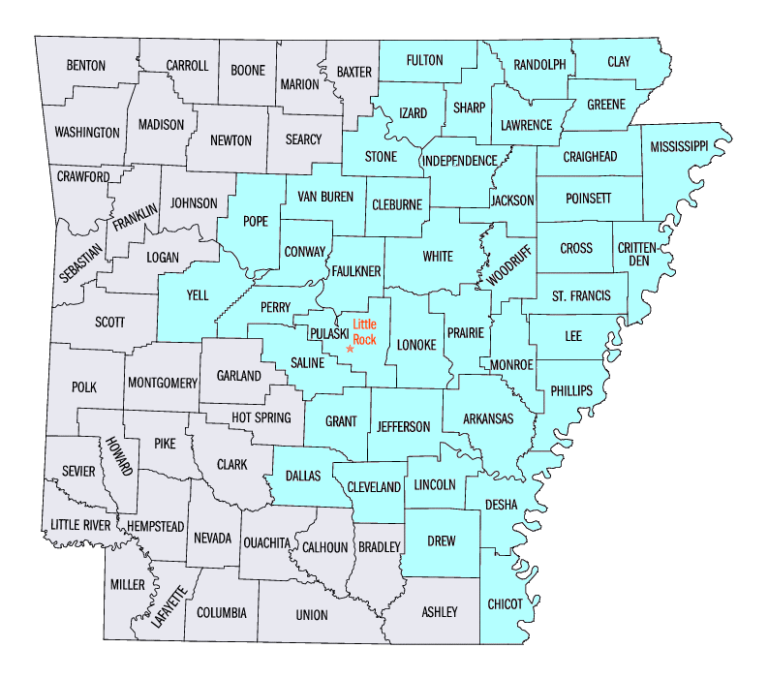
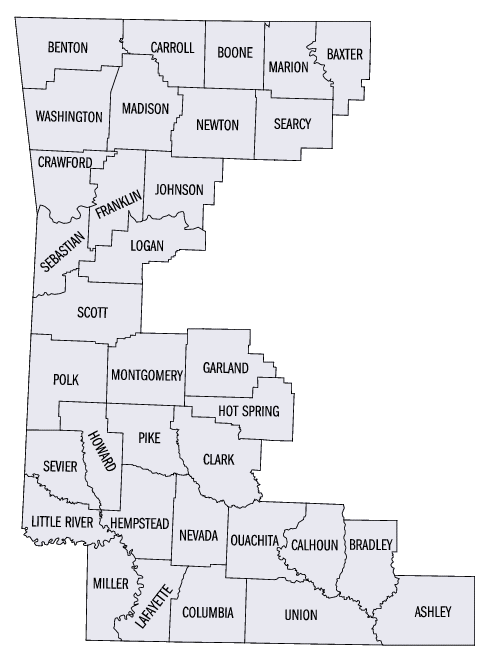

AR Code § 12-12-919
(a) Lifetime registration is required for a sex offender who:
(1) Was found to have committed an aggravated sex offense;
(2) Was determined by the court to be or assessed as a Level 4 sexually dangerous person;
(3) Has pleaded guilty or nolo contendere to or been found guilty of a second or subsequent sex offense under a separate case number, not multiple counts on the same charge;
(4) Was convicted of rape by forcible compulsion, § 5-14-103(a)(1), or other substantially similar offense in another jurisdiction; or
(5) Has pleaded guilty or nolo contendere to or been found guilty of failing to comply with registration and reporting requirements under § 12-12-904 three (3) or more times.
(b)(1)(A)(i)(a) Any other sex offender required to register under this subchapter may apply for an order terminating the obligation to register to the sentencing court fifteen (15) years after the date the sex offender first registered in Arkansas.
(b)(1)(A)(i)(b) If the sex offender was incarcerated in a correctional facility, the date the sex offender first registered in Arkansas is the date the sex offender registered upon his or her release from the correctional facility.
(ii) After fifteen (15) years of having been registered as a sex offender in Arkansas, a sex offender sentenced in another state but permanently residing in Arkansas may apply for an order terminating the obligation to register in the circuit court of the county in which the sex offender resides or has last resided within this state.
(c) If a court denies a petition to terminate the obligation to register under this section, the sex offender may not file a new petition to terminate the obligation to register under this section before three (3) years from the date the order denying the previous petition was filed.
No.
AR Code § 5-14-128
(a) A sex offender who is required to register under the Sex Offender Registration Act of 1997, § 12-12-901 et seq., and who has been assessed as a:
(1) Level 3 or Level 4 offender may not knowingly reside within two thousand feet (2,000′) of the property on which a public or private elementary or secondary school, public park, youth center, or daycare facility is located; or
(2) Level 4 offender may not knowingly reside within two thousand feet (2,000′) of a church or other place of worship.
(b)
(1) It is not a violation of this section if the property on which the sex offender resides is owned and occupied by the sex offender and was purchased prior to the date on which the public or private elementary or secondary school, public park, youth center, daycare facility, or church or other place of worship was established.
(2) The exclusion in subdivision (b)(1) of this section does not apply to a sex offender who pleads guilty or nolo contendere to or is found guilty of another sex offense after the public or private elementary or secondary school, public park, youth center, daycare facility, or church or other place of worship is established.
(c)
(1)
(A) With respect to a public or private elementary or secondary school or a daycare facility, it is not a violation of this section if the sex offender resides on property he or she owns prior to July 16, 2003.
(B) With respect to a public park or youth center, it is not a violation of this section if the sex offender resides on property he or she owns prior to July 31, 2007.
(2)
(A) The exclusion in subdivision (c)(1)(A) of this section does not apply to a sex offender who pleads guilty or nolo contendere to or is found guilty of another sex offense after July 16, 2003.
(B) The exclusion in subdivision (c)(1)(B) of this section does not apply to a sex offender who pleads guilty or nolo contendere to or is found guilty of another sex offense on or after July 31, 2007.
(3) With respect to a church or other place of worship, it is not a violation of this section if the sex offender resides on property he or she owns prior to July 22, 2015.
(f) As used in this section:
(3) “Youth center” means any building, structure, or facility owned or operated by a not-for-profit organization or by this state or a county, city, or town in this state for use by minors to promote the health, safety, or general welfare of the minors.
None.
Yes, for Levels 2, 3, & 4
AR Code § 12-12-913
(j)(1)(A) The following information concerning a sex offender registered under this subchapter who is classified as a Level 3 or Level 4 offender by the Community Notification Assessment shall be made public:
(ix) The street name and block number, county, city, and zip code where the sex offender is employed;
(x) Any institution of higher education in which the sex offender is enrolled;
(j)(1)(B) If a sex offender registered under this subchapter was eighteen (18) years of age or older at the time of the commission of the sex offense that required registration under this subchapter and the victim of the sex offense was fourteen (14) years of age or younger and the sex offender is classified as a Level 2 offender by the Community Notification Assessment, the following information concerning the registered sex offender shall be made public:
(ix) The street name and block number, county, city, and zip code where the sex offender is employed;
(x) Any institution of higher education in which the sex offender is enrolled;
While offenders must register email addresses and social media account information [AR Code § 12-12-906(g)(3)], this information is not included on the public registry.
No.
State-mandated fees are assessed by the court at the time of conviction. Any registered offender relocating to Arkansas is subject to two fees totaling $500 at the time of registration.
– Arkansas Crime Information Center
AR Code § 12-12-906
(c)(1)(B)(ii) Any offender required to register as a sex offender who is entering the State of Arkansas must provide a deoxyribonucleic acid (DNA) sample, that is, a blood sample or saliva sample, upon registration and must pay the mandatory fee of two hundred fifty dollars ($250) to be deposited into the DNA Detection Fund established by § 12-12-1119.
AR Code § 12-12-910
(b)(1) A person who relocates to this state and was convicted of an offense in another state that requires registration in this state shall pay a fee of two hundred fifty dollars ($250) within ninety (90) days from the date of registration.
AR Code § 12-12-903
(10)(A) “Residency” means the place where a person lives notwithstanding that there may be an intent to move or return at some future date to another place.
(10)(B) “Residency” also includes:
(i) A place of employment;
(ii) A place of training;
(iii) A place of education; or
(iv) A temporary residence or domicile in which a person resides for an aggregate of five (5) or more consecutive days during a calendar year;
AR Code § 12-12-906
(a)(2)(B)(ii) A nonresident worker or student who enters the state shall register in compliance with the Adam Walsh Child Protection and Safety Act of 2006, Pub. L. No. 109-248, as it existed on January 1, 2007.
AR Code § 12-12-903
(10)(A) “Residency” means the place where a person lives notwithstanding that there may be an intent to move or return at some future date to another place.
(10)(B) “Residency” also includes:
(i) A place of employment;
(ii) A place of training;
(iii) A place of education; or
(iv) A temporary residence or domicile in which a person resides for an aggregate of five (5) or more consecutive days during a calendar year;